
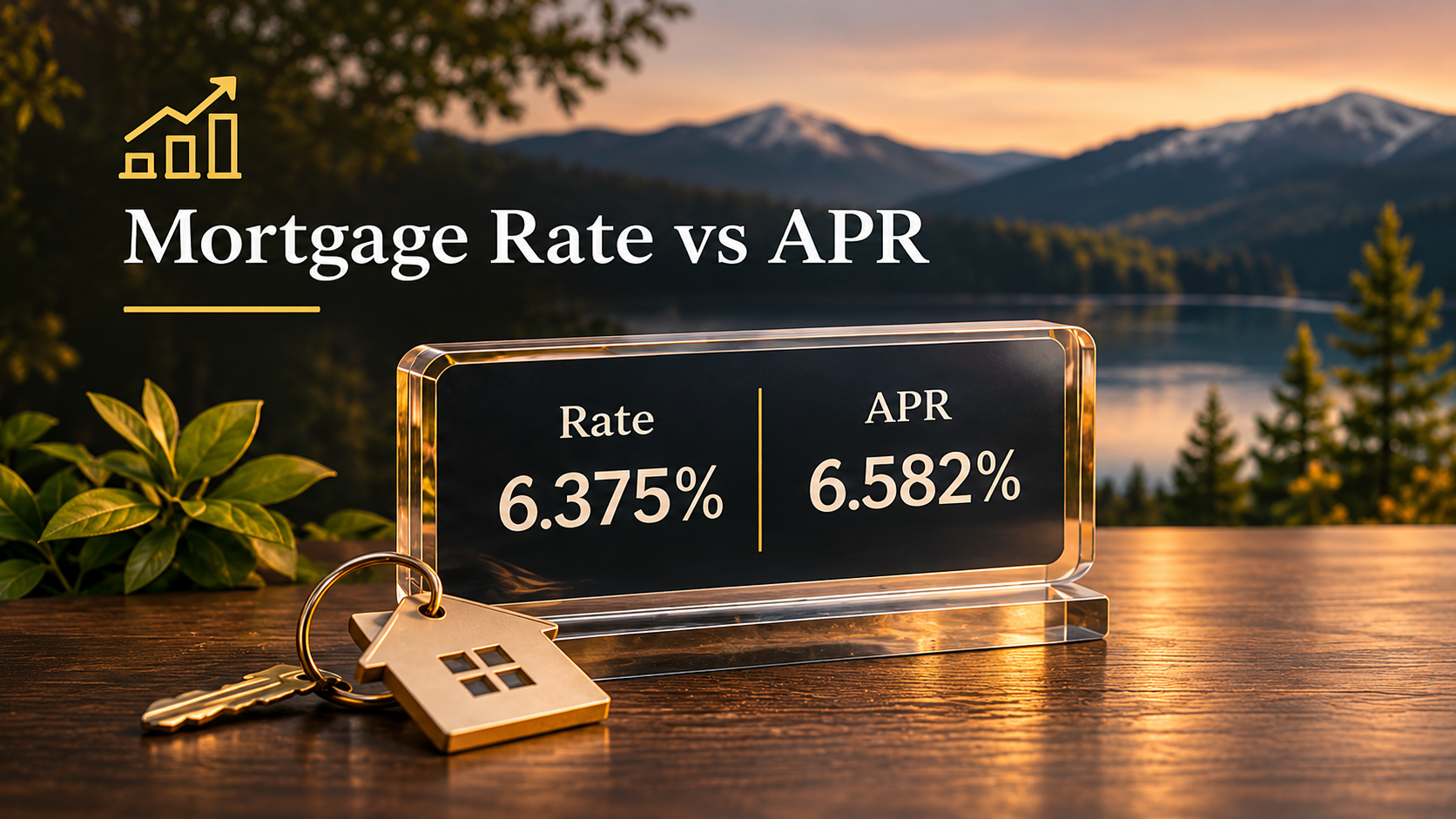
Two Numbers That Tell You Different Things About Loan Cost
Your mortgage rate helps determine the interest charged on your loan, while APR is designed to reflect the rate plus certain finance charges. Understanding the difference can help you compare mortgage offers more effectively.
Understanding Mortgage Pricing
Rate and APR Measure Different Things
Your interest rate helps determine the interest charged on your mortgage, while APR is designed to reflect the rate along with certain finance charges. Looking at both can give you a more complete picture when comparing loan options.
The Rate Used to Calculate Mortgage Interest
Rate Directly Affects Principal & Interest
A Broader Measure of Borrowing Cost
Certain Fees and Points May Affect APR
APR Assumes Costs Across the Loan Term
Review Rate, APR, Fees & Payment Together
What Is a Mortgage Interest Rate?
Your mortgage interest rate is the percentage used to calculate the interest charged on the amount you borrow.
The rate is one of the main factors used to determine the principal-and-interest portion of your monthly mortgage payment.
A lower rate generally means less interest charged on the same loan amount, assuming the loan term and other features are the same.
Two mortgages can have the same interest rate while having different points, lender charges, or other financing costs. That is one reason APR is disclosed alongside the interest rate.
What Is APR?
APR stands for annual percentage rate. It is a disclosure calculation designed to provide a broader measure of borrowing cost than the interest rate alone.
APR incorporates the interest rate along with certain finance charges associated with obtaining the loan and expresses that cost as an annualized percentage.
Because APR accounts for more than the note rate, it is commonly higher than the mortgage interest rate.
Why Is APR Usually Higher Than the Interest Rate?
The mortgage interest rate reflects the rate used to calculate interest on the loan. APR goes a step further by incorporating certain financing costs into its calculation.
When a mortgage includes charges that are treated as finance charges for APR purposes, those costs increase the effective annualized percentage shown as APR.
Interest Rate
Primarily tells you the rate used to calculate interest on the outstanding loan balance.
APR
Uses the interest rate plus certain qualifying finance charges to provide a broader annualized cost measure.
What Costs Can Affect APR?
APR does not simply add every closing cost to your interest rate. Disclosure rules determine which charges are treated as finance charges and therefore affect the APR calculation.
Depending on the loan and fee structure, costs that may affect APR can include:
Discount points
Certain origination charges
Certain mortgage insurance charges
Other charges classified as finance charges
APR follows a specific disclosure calculation. Some costs affect APR and others do not, even though they may still appear on your Loan Estimate or Closing Disclosure.
Are All Closing Costs Included in APR?
No. APR is not intended to represent every dollar you will pay at closing.
Some costs are associated with purchasing, transferring, or owning the property rather than obtaining the credit itself. Those charges may not be treated as finance charges for APR purposes.
Prepaid items and escrow-related amounts can also affect your cash needed at closing without necessarily being reflected in APR the same way as financing charges.
This is why APR should be reviewed alongside your complete Loan Estimate, monthly payment, closing costs, and cash to close.
Does a Lower APR Always Mean a Better Loan?
Not necessarily.
APR can be helpful when comparing loans with similar structures, but it does not determine which mortgage best fits every borrower.
For example, one loan may have a lower APR because additional money is being paid upfront to obtain a lower interest rate. Another loan may have a somewhat higher APR but require less cash at closing.
Your available cash, monthly-payment goals, loan structure, and overall financial priorities can all matter when deciding between mortgage options.
How Do Discount Points Affect Rate and APR?
Discount points are upfront costs paid in exchange for a lower mortgage interest rate.
Paying points can reduce the monthly principal-and-interest payment, but because points are paid upfront and generally affect the cost of obtaining the loan, they can also influence APR.
This creates a tradeoff between the amount paid at closing and the amount paid each month.
More Upfront Cost
Paying discount points increases the amount paid upfront to obtain the mortgage.
Lower Interest Rate
In exchange, the mortgage rate and monthly principal-and-interest payment may be lower.
Whether paying points makes sense depends on the individual loan structure and borrower goals—not simply on which option produces the lowest advertised rate.
How Should You Compare Two Mortgage Offers?
The most useful mortgage comparison looks at loans with similar terms and structures and evaluates several numbers together rather than relying on a single headline figure.
Important items to review include:
Interest rate
APR
Discount points
Lender fees and credits
Monthly principal & interest
Total cash required at closing
It is also important to compare similar loan programs, terms, and pricing periods. Mortgage rates can move with financial markets, so quotes obtained on different days may reflect different market conditions.
Your interest rate and monthly payment can also affect how much home fits within your qualifying budget, which connects mortgage pricing with your debt-to-income ratio and overall mortgage pre-approval .
The clearest comparison uses similar loan amounts, loan programs, terms, rate-lock periods, and points or credits. That makes it much easier to see where the true differences are.