
How Much of Your Income Goes Toward Monthly Debt?
Your debt-to-income ratio compares your monthly debt payments with your qualifying income. It is one of the key measurements lenders use when evaluating how much mortgage payment your finances may support.
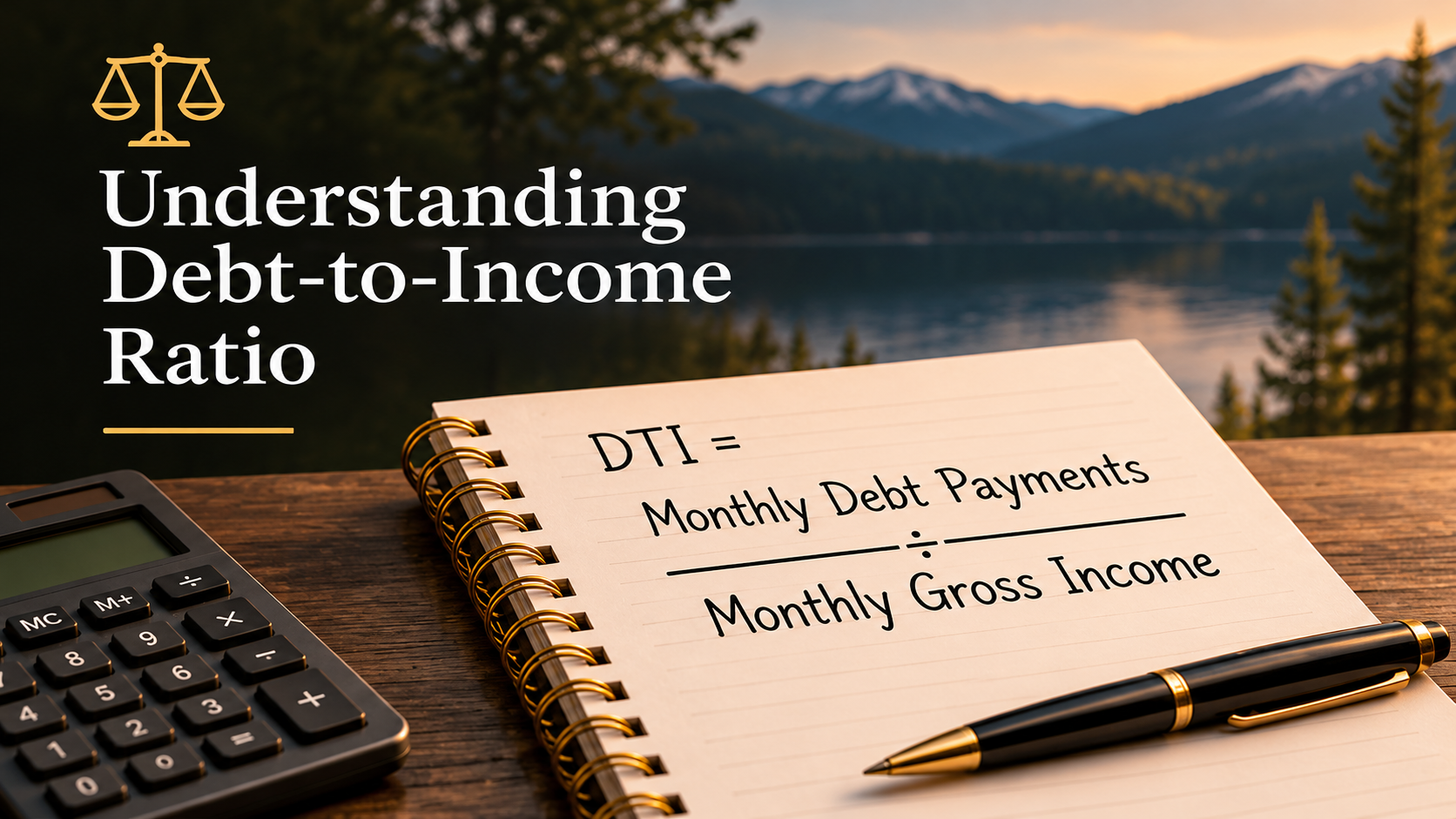
Understanding Debt-to-Income Ratio
What Goes Into Your DTI?
Your debt-to-income ratio compares qualifying monthly debt obligations with your gross monthly income. The proposed housing payment is only one part of the calculation.
Gross Monthly Qualifying Income
Mortgage, Taxes, Insurance & HOA
Monthly Vehicle Loan or Lease Payments
Required or Calculated Monthly Payments
Minimum Required Monthly Payments
Other Recurring Debts That Must Be Counted
What Is Debt-to-Income Ratio?
Debt-to-income ratio, commonly called DTI, compares certain monthly debt obligations with the gross monthly income that can be used to qualify for a mortgage.
Lenders use DTI as one way to evaluate whether the proposed housing payment and your other recurring debts appear manageable relative to your qualifying income.
DTI is important, but it is only one part of the mortgage approval process. Credit, assets, reserves, loan program, property type, and automated underwriting findings can matter too.
Basic DTI Formula
Monthly Qualifying Debt Payments ÷ Gross Monthly Qualifying Income = DTI
For mortgage qualification, the income and debt amounts used in the calculation must follow the applicable loan-program and underwriting rules.
How Is DTI Calculated?
Start with the monthly obligations that must be counted for mortgage qualification. Then divide that amount by the gross monthly income the lender can use to qualify you.
For example, if a borrower has $3,000 in qualifying monthly obligations and $8,000 in qualifying gross monthly income:
This is a simplified example. The actual mortgage calculation depends on which debts and income sources must be included under the applicable loan guidelines.
What Income Is Used for DTI?
Mortgage DTI is not necessarily calculated from the amount deposited into your bank account or the take-home pay shown on your paycheck.
Lenders generally work with gross qualifying income before taxes and deductions, provided the income meets the documentation, stability, and continuance requirements of the selected loan program.
Depending on the borrower, qualifying income may come from sources such as:
Salary or hourly wages
Overtime, bonus, or commission income
Self-employment income
Social Security or retirement income
Rental income
Other eligible recurring income
The amount a borrower earns and the amount a lender can use for mortgage qualification are not always the same. This is why complete income documentation can be important during pre-approval.
What Is Included in the Proposed Housing Payment?
Mortgage qualification generally looks at more than principal and interest. The qualifying housing payment may also include other recurring costs associated with the property.
Principal & Interest
The scheduled principal and interest payment on the new mortgage.
Property Taxes
The monthly amount used to account for property taxes on the home.
Homeowners Insurance
The monthly equivalent of the homeowners insurance premium used for qualification.
Mortgage Insurance
Mortgage insurance or similar program-specific charges may be included when applicable.
HOA Dues
Homeowners association dues or similar recurring housing obligations may also be counted.
Other Housing Obligations
Certain property-specific recurring obligations may need to be considered depending on the transaction.
Front-End vs. Back-End DTI
You may hear two different debt-ratio terms during the mortgage process.
Front-End Ratio
Compares the proposed housing payment with qualifying gross monthly income. This is sometimes called the housing ratio.
Back-End Ratio
Includes the proposed housing payment plus the other qualifying monthly debts that must be counted. This is typically what people mean when discussing total DTI.
What Is a Good DTI for a Mortgage?
There is no single debt-to-income ratio that applies to every mortgage.
Acceptable DTI can vary based on the loan program, automated underwriting findings, credit profile, reserves, loan-to-value, property type, occupancy, and other factors.
In general, a lower DTI gives the loan more room because less of the borrower's qualifying income is already committed to recurring debt payments. A higher DTI may still be acceptable in some situations, but the overall file generally becomes more important.
Two borrowers with the same DTI can receive different underwriting results because their credit, assets, reserves, down payment, loan program, and other risk factors are different.
How Loan Programs Treat DTI Differently
Different mortgage programs evaluate debt ratios differently, and automated underwriting can allow flexibility based on the strength of the overall file.
Conventional Loans
Conventional loans frequently rely on automated underwriting to evaluate the complete borrower profile rather than looking at DTI in isolation.
FHA Loans
FHA financing can provide flexibility for some borrowers, but the acceptable ratio depends on the underwriting method, compensating factors, and lender requirements.
VA Loans
VA underwriting considers the borrower's overall ability to repay and also places significant emphasis on residual income in addition to the debt ratio.
USDA Loans
USDA financing has program-specific ratio guidance and underwriting requirements, with potential flexibility depending on the file and approval method.
Non-QM Loans
Non-QM programs can use different income methods and ratio limits. The acceptable DTI varies substantially by lender and product.
Down Payment Assistance
Assistance programs may have additional debt-ratio requirements beyond those of the underlying first mortgage.
Why Can Two Borrowers With the Same DTI Get Different Results?
Mortgage underwriting evaluates risk across the entire loan file. DTI is important, but it does not exist in isolation.
Other factors may include:
Down payment
Cash reserves
Loan-to-value
Income stability
Automated underwriting findings
This is why a complete mortgage pre-approval is much more useful than trying to determine whether you qualify from a DTI percentage alone.
How Can You Lower Your DTI?
Because DTI is a relationship between qualifying income and qualifying debt, the ratio can generally improve by reducing counted monthly obligations, increasing qualifying income, or lowering the proposed housing payment.
Reduce Monthly Obligations
Lower qualifying monthly debt payments can improve the ratio. Which obligations are most useful to address depends on the individual loan file.
Increase Qualifying Income
Additional eligible income may improve DTI when it can be documented and meets the applicable mortgage-program requirements.
Adjust the Housing Payment
A lower purchase price, different interest rate, lower taxes, or different property can change the proposed housing expense.
Consider a Different Loan Structure
Different mortgage programs can treat income, debts, and underwriting risk differently. The best solution is not always simply reducing the purchase price.
Before using cash to pay off debt, it can be helpful to compare the improvement in qualification with the amount of money needed for your down payment, closing costs, and reserves .