
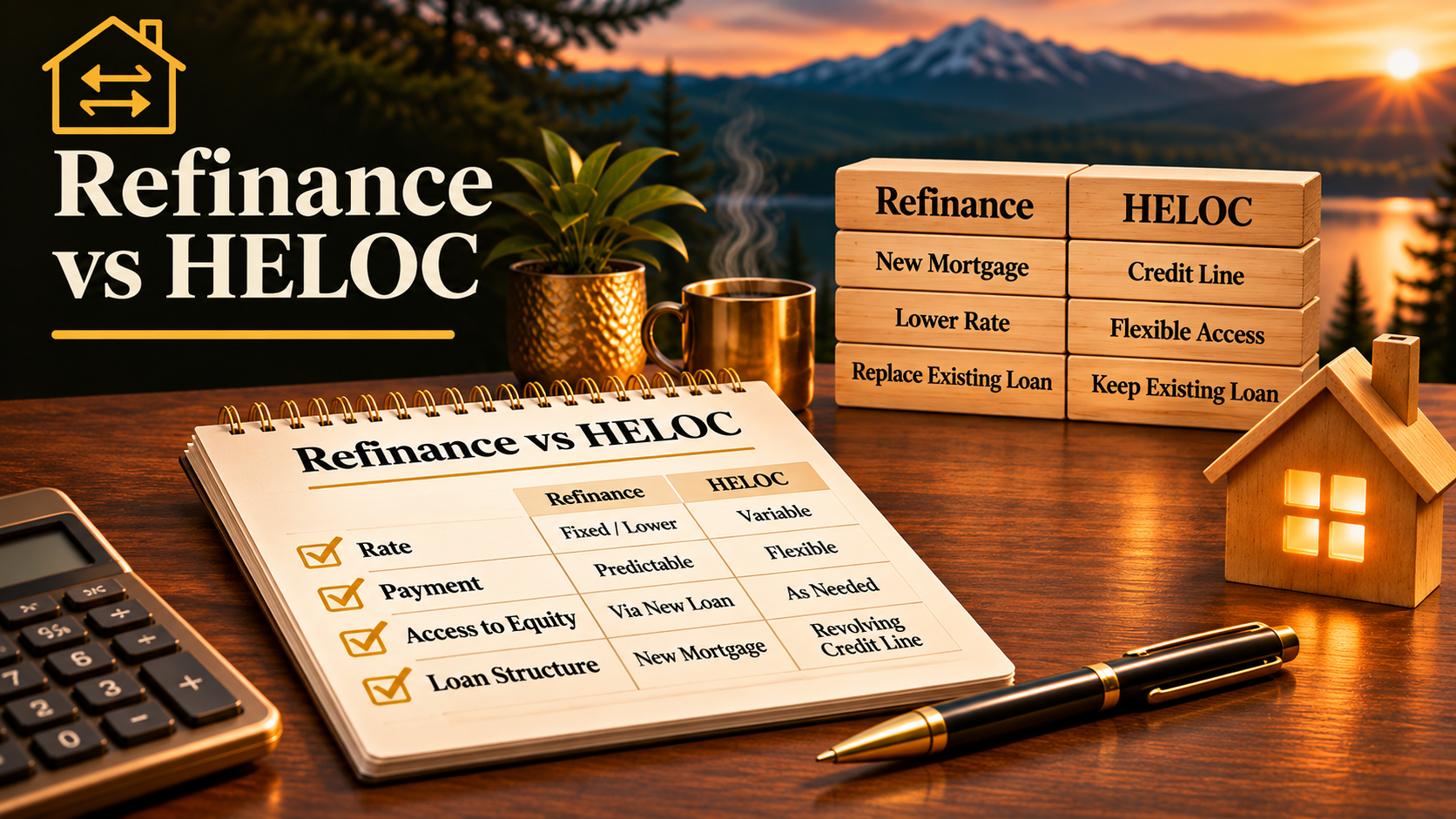
Choosing How to Access Your Home Equity
A cash-out refinance and a home equity line of credit can both provide access to the equity in your home, but they work very differently. A refinance replaces your existing mortgage with a new loan, while a HELOC generally leaves the first mortgage in place and adds a separate revolving line of credit. Comparing the rate structure, monthly payment, closing costs, flexibility, and the terms of your current mortgage can help determine which approach better fits your goals.
Comparing Your Equity Options
A Refinance and a HELOC Access Equity in Very Different Ways
A refinance replaces your existing mortgage with a new loan, while a HELOC typically leaves the first mortgage in place and adds a separate revolving line of credit. The better structure depends on your current mortgage, how much equity you need, and how you expect to use the funds.
Refinance Replaces the First Mortgage; HELOC Adds a Separate Second Loan
Refinances Often Use Fixed Rates; HELOC Rates Are Commonly Variable
Refinance Provides Proceeds at Closing; HELOC Lets You Draw Funds as Needed
A HELOC Can Preserve an Attractive First Mortgage Instead of Replacing It
What Is the Difference Between a Refinance and a HELOC?
A refinance and a home equity line of credit can both provide access to home equity, but the way the money is borrowed is usually very different.
A cash-out refinance typically replaces your existing first mortgage with a new, larger closed-end mortgage. A traditional HELOC usually leaves the first mortgage in place and adds a separate revolving line of credit secured by the property.
If your existing mortgage has favorable terms, keeping it in place can be a major reason to consider a HELOC. If replacing the first mortgage itself is part of the goal, a refinance may deserve a closer look.
How Does a Cash-Out Refinance Work?
A cash-out refinance replaces the existing mortgage with a larger new loan. Part of the new mortgage pays off the current loan, and eligible remaining proceeds may be received as cash at closing.
Because the entire first mortgage is being replaced, the interest rate, loan term, monthly payment, and financing costs on the full balance may change.
Learn more in our Cash-Out Refinance guide .
How Does a HELOC Work?
A HELOC is a revolving line of credit secured by the home. Instead of receiving one fixed loan amount that is fully advanced at closing, borrowers can typically draw from the available credit line as needed during the applicable draw period, subject to the terms of the HELOC.
Many HELOCs are placed in second lien position behind an existing first mortgage, which allows the homeowner to preserve that first loan while accessing additional equity separately.
Can a HELOC Replace Your First Mortgage?
Yes, in some cases. While many HELOCs are used as second liens, specialized first-position HELOC products can replace the existing mortgage and become the primary lien against the property.
These products are less common than traditional second-lien HELOCs and may use a different repayment or cash-flow structure. The rate, fees, draw features, payment requirements, and long-term strategy should be reviewed carefully.
Second-lien HELOCs are the more common structure, but first-position HELOCs do exist. The lien position and repayment structure should always be confirmed when comparing products.
Why Does Your Current Mortgage Rate Matter?
Your existing first mortgage can be one of the most important parts of this decision.
If your current mortgage has a particularly attractive rate or favorable terms, replacing the entire balance with a cash-out refinance may increase the cost of borrowing on money you were already financing under better terms.
A second-lien HELOC can allow that first mortgage to remain unchanged while only the additional amount borrowed against the property is placed into the new line of credit.
How Do the Interest Rates Compare?
The rate structure can be very different between the two options.
Cash-Out Refinance
Many refinance mortgages use a fixed interest rate, which can provide a predictable principal-and-interest payment for the term of the loan.
HELOC
HELOCs commonly use variable rates, which means the rate and required payment may change over time. Product structures can vary.
Do You Need All the Money at Once?
How you plan to use the equity can help determine which structure is more useful.
A cash-out refinance generally provides eligible proceeds as part of the closing transaction. A HELOC can provide a revolving source of funds that may be drawn over time, up to the available line and subject to the loan terms.
Large One-Time Need
A refinance may be worth comparing when a substantial amount of equity is needed at once and replacing the first mortgage also makes financial sense.
Ongoing or Uncertain Needs
A revolving HELOC can offer flexibility when you expect to use funds in stages or want access to a line without borrowing the full amount immediately.
How Do the Monthly Payments Differ?
With a cash-out refinance, the new mortgage payment is based on the full new loan balance and the terms of the replacement mortgage.
With a HELOC, the required payment depends on the amount actually borrowed, the HELOC's rate, and the repayment terms. Some HELOCs may have different payment structures during the draw and repayment periods.
A lower required payment does not automatically mean lower total borrowing cost, so the repayment structure should be compared carefully.
What About Closing Costs?
Both options can involve costs, but the amount and structure may differ. A refinance may include lender charges, title and settlement services, appraisal costs, recording fees, prepaid items, and escrow-related funds.
HELOCs may also include lender, appraisal, title, recording, annual, or other applicable charges depending on the product. Some programs may offset or waive certain costs under specific conditions.
For more on refinance expenses, see Refinance Closing Costs .
How Does Home Equity Affect Both Options?
Both a refinance and a HELOC depend in part on the relationship between the property's value and the debt secured by the home.
The lender may evaluate loan-to-value or combined loan-to-value when determining the available loan amount or credit line. Requirements vary by product, property, occupancy, credit profile, and other qualification factors.
See How Much Equity Do You Need to Refinance? for a deeper explanation.
When Might a Cash-Out Refinance Make More Sense?
A cash-out refinance may deserve consideration when replacing the first mortgage itself creates a benefit in addition to accessing equity.
The new first-mortgage terms are attractive
You want a single mortgage payment
You need a substantial amount at closing
A fixed-rate structure fits your goals
When Might a HELOC Make More Sense?
A traditional second-lien HELOC may be worth comparing when the existing first mortgage is attractive and you primarily need access to additional equity.
You want to preserve your current first mortgage
You want revolving access to equity
You may need funds in stages
You are comfortable with the HELOC's rate and payment structure
Compare the Whole Structure — Not Just the Rate
The better option depends on more than which loan advertises the lower rate. Compare what happens to your existing first mortgage, how much you need to borrow, whether you need the funds all at once, how the interest rate can change, the monthly payment, closing costs, and how long you expect to carry the debt.
For some homeowners, preserving an attractive first mortgage can be valuable. For others, replacing the first mortgage and accessing equity through one new loan may create the better overall structure.