
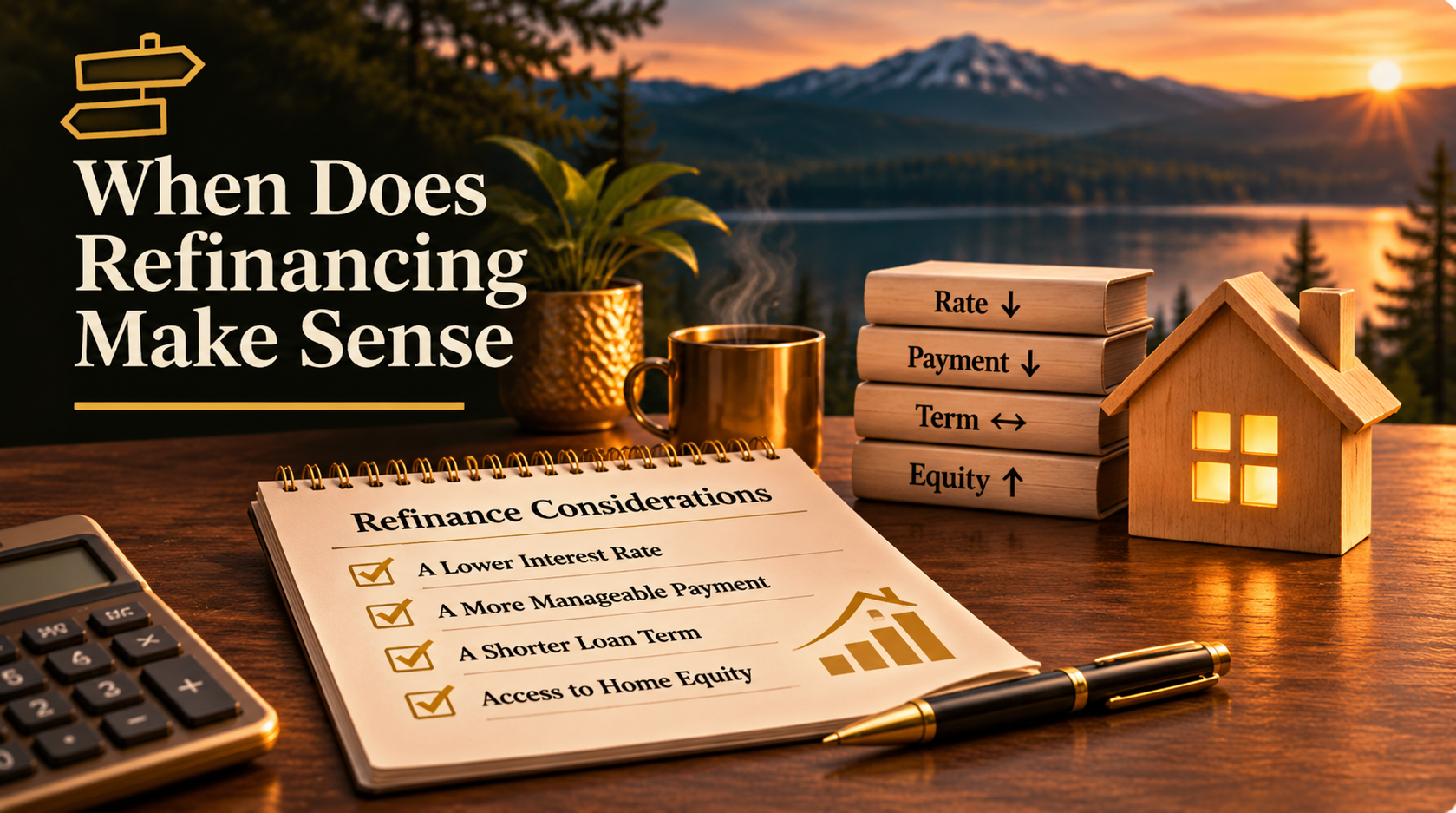
Evaluating Whether a Refinance Is Worth It
A lower interest rate can make refinancing attractive, but the rate alone does not determine whether replacing your mortgage is worthwhile. Monthly savings, closing costs, the new loan term, your remaining balance, available equity, and how long you expect to keep the loan all affect the decision. Looking at those factors together can help you determine whether refinancing actually improves your financial position.
Evaluating a Refinance
A Lower Rate Is Only One Part of the Decision
Refinancing can make sense when the new mortgage creates enough benefit to justify replacing the loan you already have. The rate matters, but so do the monthly savings, closing costs, new loan term, and how long you expect to keep the mortgage.
Determine How Much the New Loan Could Actually Change Your Payment
Compare the Cost of the Refinance With the Benefit You Expect to Receive
Consider Whether the Refinance Shortens or Extends Your Payoff Timeline
The Longer You Keep the New Loan, the More Time It Has to Provide Value
When Can Refinancing Make Sense?
Refinancing can make sense when replacing your existing mortgage creates a meaningful financial or strategic benefit. That benefit might come from a lower interest rate, a different monthly payment, a shorter loan term, access to home equity, or a better loan structure.
The important question is not simply whether the new mortgage looks better. It is whether the improvement is large enough to justify the cost and tradeoffs of replacing the loan you already have.
Does a Lower Interest Rate Make Refinancing Worth It?
A lower rate can improve the economics of a mortgage, but there is no single rate reduction that automatically makes refinancing worthwhile.
The actual benefit depends on the loan balance, new interest rate, remaining term of the existing mortgage, new loan term, closing costs, and how long you expect to keep the new loan.
A smaller rate reduction may be meaningful on a large loan with low costs, while a larger rate reduction may still provide limited value if the loan is small, expensive to refinance, or likely to be paid off soon.
What If the Refinance Lowers Your Monthly Payment?
Reducing the monthly payment can improve cash flow, but it is important to understand why the payment is lower.
Lower Rate
A lower interest rate may reduce the principal-and-interest payment without necessarily extending the repayment period.
Longer Loan Term
Restarting with a longer loan term can lower the payment even if the rate improvement is modest, but it can also extend the payoff timeline.
Different Loan Structure
Changes to mortgage insurance, loan program, or other financing features can also affect the new monthly payment.
What Is the Refinance Break-Even Point?
The break-even point is one useful way to compare the cost of refinancing with the expected monthly savings.
A simple break-even estimate divides the refinance costs being evaluated by the expected monthly savings. The result shows approximately how many months it may take for those savings to offset those costs.
Simple Break-Even Example
This is a simplified example for illustration. A complete comparison may also consider changes in loan term, interest paid over time, financed costs, mortgage insurance, and other differences between the loans.
How Long Do You Expect to Keep the Mortgage?
Your time horizon can significantly affect whether refinancing makes sense. If you expect to keep the new loan for many years, there may be more time for ongoing savings or other benefits to outweigh the cost of refinancing.
If you expect to sell the home, pay off the loan, or refinance again before reaching the expected break-even point, the financial benefit may be smaller.
Are You Restarting the Loan Term?
One of the easiest refinance tradeoffs to overlook is the new repayment period. If you are several years into your current mortgage and replace it with a new long-term loan, the monthly payment may fall partly because you are spreading repayment over more years.
That does not automatically make the refinance a poor choice, but the new term should be compared with the number of years remaining on the current mortgage.
A refinance can improve monthly cash flow while extending repayment. Decide whether your priority is the payment today, the payoff timeline, total borrowing cost, or a combination of those goals.
Can Refinancing Help You Pay the Mortgage Off Faster?
Yes. Some homeowners refinance into a shorter loan term rather than using the refinance primarily to reduce the payment.
A shorter term may increase the required monthly principal-and-interest payment, but it can accelerate principal repayment and shorten the time until the loan is scheduled to be paid off.
What If Your Goal Is to Access Home Equity?
A refinance does not have to be justified solely by a lower rate. A cash-out refinance may make sense when accessing equity is itself an important financial objective.
In a cash-out transaction, the new mortgage is generally larger than the amount required to pay off the existing loan, allowing eligible equity to be converted into cash at closing.
Because this changes both the mortgage balance and potentially the interest rate on the entire first mortgage, it is important to compare a cash-out refinance with other ways of accessing equity.
Should You Refinance or Keep Your Current Mortgage?
If your existing first mortgage has attractive terms, replacing the entire loan simply to access equity may not always be the only strategy worth considering.
A HELOC or other second-lien option may allow you to keep the existing first mortgage in place while borrowing separately against available equity. The better structure depends on the rates, costs, payment, amount needed, and your longer-term plans.
See our comparison of refinance vs. HELOC .
How Much Do Refinance Closing Costs Matter?
Closing costs are a central part of the refinance decision because they reduce the net benefit of replacing the existing mortgage.
Costs can vary depending on the loan, property, lender, title or settlement services, appraisal requirements, recording charges, and other transaction details.
Some costs may be paid at closing, while certain costs may sometimes be incorporated into the financing depending on the loan structure and available equity. Financing a cost does not make it disappear—it generally becomes part of the new loan.
Learn more in our guide to refinance closing costs .
Does Home Equity Affect Whether You Can Refinance?
Equity can affect which refinance structures are available and how the new loan is priced. The relationship between the property's value and the new loan amount is commonly expressed as the loan-to-value ratio.
The amount of equity needed depends on the loan program, property, occupancy, credit profile, and whether the refinance includes cash out.
What Are Good Reasons to Consider Refinancing?
Refinancing can serve several different purposes. The strongest reason depends on what you want the new mortgage to accomplish.
Reduce the interest rate
Improve monthly cash flow
Shorten the payoff timeline
Access available home equity
Change loan programs
Change or eliminate certain financing costs
When Might Refinancing Not Make Sense?
Refinancing may provide limited benefit when the savings are small relative to the costs, when you expect to keep the loan for only a short period, or when the new structure works against your larger financial goals.
Long Break-Even Period
If it would take longer to recover the costs than you expect to keep the mortgage, the refinance may provide little financial benefit.
Attractive Existing Loan
Replacing an existing mortgage with favorable terms should be evaluated carefully, particularly when the new transaction is being considered for a secondary goal such as accessing equity.
Compare the New Mortgage With the One You Already Have
The best way to evaluate a refinance is to compare the complete new loan against the mortgage you already have.
Look at the interest rate, monthly payment, closing costs, new loan amount, repayment term, break-even period, equity position, and how long you expect to keep the mortgage.
A refinance makes the most sense when those pieces work together to support a clear financial goal—not simply because one number on the new loan looks better.